
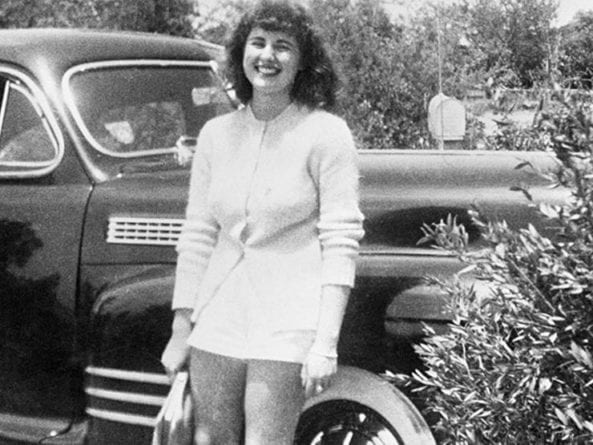
In October of 1944, Georgette Elise Bauerdorf, 20, was working as a junior hostess at the Hollywood Canteen, where she entertained servicemen on layover before heading to war (Thompson, 2017), and for the Los Angeles Times Women’s Service Bureau (Tilstra, 2016). Georgette was the daughter of George Bauerdorf, a man who made billions in Oklahoma from oil, and lived in the El Palacio apartments in a family owned apartment (Thompson, 2017). Georgette was born in 1924, to George and his wife Constance, who died in 1935. She and her sister, Connie, attended a convent school on Long Island where they were trained in propriety and goodness, before moving to California after their mother’s death (Tilstra, 2016). There, the two attended Marlborough School in Los Angeles, an all-girls prep school where students were called “Violets,” and later West Lake School for Girls. In 1941, Georgette graduated (Georgette Bauerdorf: Murder at El Palacio, n.d.).
On October 11, 1944, Georgette’s friends noted that she had seemed agitated before going into work at the Hollywood Canteen. She had even asked her friend, June Ziegler, to stay the night with her at her apartment, which unfortunately for Georgette never happened (Georgette Bauerdorf: Murder at El Palacio, n.d.). It was a Wednesday night, and just as any other Wednesday night, Georgette was dancing with and entertaining servicemen. By all accounts, it was an ordinary night at the Hollywood Canteen (Tilstra, 2016). On her way home, she picked up Sergeant Gordon Aadland and drove him for approximately 10 to 15 minutes towards his destination. After her murder, Sergeant Aadland sent a letter to the local authorities about the event and initially claimed that she seemed agitated and nervous. Later he would revise, stating that in retrospect what he thought was agitation and nervousness may have just been Georgette being attentive to the road. He admitted thinking about warning her of the dangers of picking up strangers as she had, but never did (Georgette Bauerdorf: Murder at El Palacio, n.d.).
At approximately 11 AM on October 12, 1944, Frank Atwood, the janitor for the El Palacio apartments, his wife and his daughter were doing their usual cleaning of the apartments. The first sign that something was wrong was Georgette’s apartment door being open and the outside light being off. When the three entered the apartment, Mrs. Atwood noticed the sound of someone in the bath and headed upstairs, where she would call for her husband after finding Georgette face down in the bath tub. Initially, Frank thought she must have fainted and reached to drain the tub, admitting later to touching her right forearm. When it was apparent that Georgette was dead and not unconscious, authorities were contacted. By the time authorities arrived, rigor mortis had set in, meaning she had been dead for some time. Despite that, Atwood described her as still being warm, possibly due to the scalding temperature of the water she was left in (Thompson, 2017) (Tilstra, 2016) (Georgette Bauerdorf: Murder at El Palacio, n.d.).
Georgette was half naked, only wearing the top half of a pink pajama set. She had been beaten and strangled before being left in her bath tub, face down with the tap running slowly with scalding hot water. Her attacker used enough force on her that fingerprints were left on her skin, along with contusions and bruises (Thompson, 2017). She had been raped before being strangled and a nine inch by nine inch piece of cloth, possibly a piece of towel or wrap bandage, was shoved down her throat with an inch of it sticking out from her mouth. Her official cause of death was ruled as strangulation (Georgette Bauerdorf: Murder at El Palacio, n.d.).
The investigation began quickly. It was discovered that the light outside her apartment had been unscrewed and was covered in fingerprints. The theory was that her killer had been lying in wait. The timeline investigators were working with began with Georgette leaving the Hollywood Canteen around 11:30 PM. She got home, after giving Sergeant Aadland a ride, and made herself a snack in her kitchen. Sometime after that, her killer attacked (Tilstra, 2016). Some cash had been taken from the apartment, but Georgette’s jewelry that was left out was left alone. Her car, however, was missing from the garage and was not parked in other regular parking spots (Thompson, 2017).
When talking with her friends, investigators learned that Georgette occasionally changed with the curtains in her apartment open. It is possible that her killer may have been watching her from a distance, possibly for quite some time. Neighbors questioned didn’t see anyone else going into Georgette’s apartment. One neighbor reported hearing her screaming, begging someone to stop and saying they would kill her, but attributed it to a domestic dispute and went back to sleep (Thompson, 2017). Atwood would tell investigators that he thought he heard the sound of high-heeled footsteps coming from her apartment that night, followed by a crash, but never followed up on the sound. He was unable to confirm if there was a second person in the apartment (Tilstra, 2016).
Her work at the Hollywood Canteen made for a long list of suspects, and it was not out of character for her to give servicemen rides home and even invite them into her house for a meal (Thompson, 2017). After a high school student found and turned in a letter addressed to investigators, Georgette’s friend June informed investigators of a tall soldier Georgette had been seeing shortly, but ended things with because she just didn’t like him (Georgette Bauerdorf: Murder at El Palacio, n.d.). The note, received in 1945, claimed that Georgette’s killer would be at the Hollywood Canteen between the arrival of the letter and the one year anniversary of her murder. According to the letter, her killer had been stationed at Okinawa and would be in uniform when they found him, if they found him (Thompson, 2017). Friends also informed investigators of a soldier at the Hollywood Canteen of a soldier who wouldn’t stop harassing Georgette to dance the jitterbug with him, despite the fact that she preferred slower dances. According to June, Georgette had told her she danced with him just to avoid any further trouble from him. This soldier, along with a sailor who also frequented the Hollywood Canteen, were brought in for questioning, but were released by investigators after being ruled out. A secret boyfriend, Jerome M. “Jerry” Brown, was also ruled out after questioning. Georgette had been planning to visit him in El Paso. The two had met at the Hollywood Canteen on June 13th and had exchanged letters for some time. The plane tickets had already been bought and were on her dresser(Thompson, 2017).
While the case is officially unsolved, there have been several suspects and false confessions. In December of 1944, John Lehman Sumter, 22, walked into the San Francisco FBI Office and claimed to have killed her. He told a story about Georgette inviting him into her home, where he had a cup of coffee. A soldier visited during this time, staying for an hour after which time Sumter claimed to have murdered her (Georgette Bauerdorf: Murder at El Palacio, n.d.). Sumter brought a detective magazine with him and told investigators, if they wanted to know how he killed her, they could read it there. The confessions was inconsistent with the evidence and his story had many discrepancies (Thompson, 2017). Sumter later confessed he made the false confession because he wanted to die and was too scared to kill himself, so he sought out the death penalty. According to his family, he spent some time in a Georgia sanitorium (Georgette Bauerdorf: Murder at El Palacio, n.d.).
Kenneth Raymond, a 23-year old army deserter, was accused of kidnapping and killing 6-year old Rochelle Gluskoter in the 1940s. At the time of his arrest in 1946 he was questioned in Georgette’s murder despite no evidence tying him to the murder. He was known also as Raymond Pulaski, and described as a “one man crime wave,” with a long history of assault and robbery. A Robert George Pollock White was arrested in San Diego after reportedly attacking a 65-year old woman and shoving a cloth down her throat. At the time of Georgette’s murder, White was in Los Angeles (Georgette Bauerdorf: Murder at El Palacio, n.d.). Some believe Georgette’s murder may be connected to the murder of Elizabeth Short, the Black Dahlia. Her car was eventually found near where Short’s body would be found, though fingerprints from the car would be as fruitless as the fingerprints from her apartment. Like Georgette, Short had also worked at the Hollywood Canteen where they would have known each other and had several mutual acquaintances (Thompson, 2017). On top of this, there was a suspect on the periphery of each case, Jack Anderson Wilson (Tilstra, 2016).
Georgette’s remains were eventually shipped back to her family in New York, where she was interred in a family-owned plot in a cemetery on Long Island (Tilstra, 2016). Her family has never gotten closure in her death. To this day, nearly 77 years later, the case remains unsolved.
Georgettebauerdorf.com. n.d. Georgette Bauerdorf: Murder at El Palacio. [online] Available at: <http://www.georgettebauerdorf.com/> [Accessed 4 July 2021].
Tilstra, E., 2016. The Unsolved Killing of Georgette Bauerdorf. [online] https://the-line-up.com. Available at: <https://the-line-up.com/georgette-bauerdorf-unsolved> [Accessed 4 July 2021].
Thompson, E., 2017. A Hollywood Crime – Georgette Bauerdorf • Morbidology. [online] Morbidology. Available at: <https://morbidology.com/a-hollywood-crime-georgette-bauerdorf/> [Accessed 1 July 2021].

 Syn Writes