
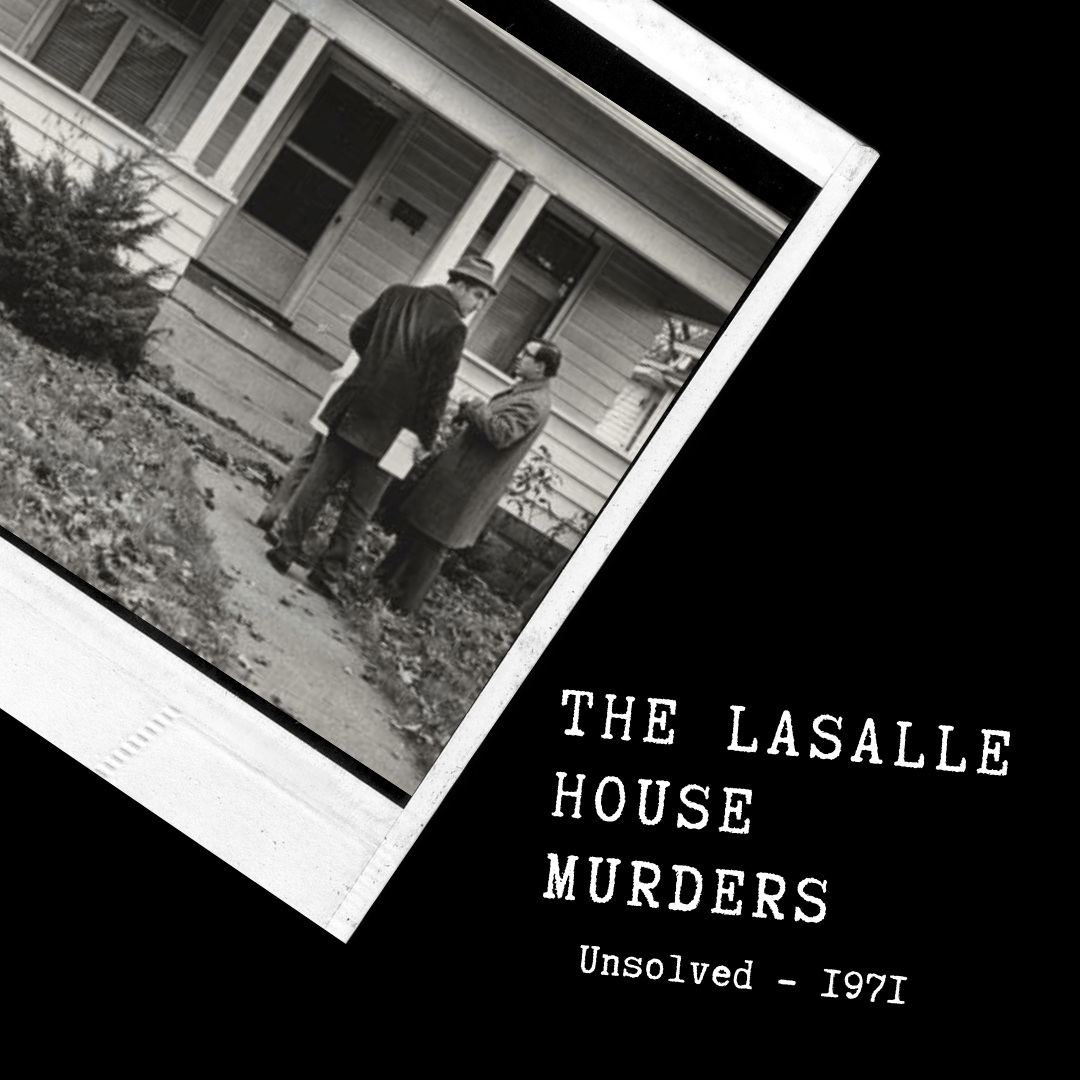
When Robert Hinson, 30, and Robert Gierse, 34, hadn’t shown up to work on December 1, 1971, it wasn’t initially concerning (Penner, and Knapp). According to Louise Cole, a secretary at their business B&B Microfilm Services, both men had been at work later the night before. According to her, the two men were still hard at work when she left at 5:15 PM that night. Eventually, their absence became concerning, both men seemingly unreachable, and John Karnes was sent to check up on them at the now infamous house on North LaSalle street. After finding the crime scene, Karnes called investigators and described the scene as inhuman (Hoover).
The case was complicated from the start, due partially to the sheer number of possible suspects. The three victims, Hinson, Gierse, and James Barker, 27, were known to frequent local bars and get involved in bar fights. They were involved with a contest at one of these bars, involving having sex with as many women a month as possible and reporting in each month with total numbers (Hoover). Retired investigator Robert Snow has said a scorecard was being kept at the LaSalle house, with approximately 60 names on the card (Adams). Among the many suspects were these women, who may have felt jilted by the men, and their boyfriends or husbands who would have been angry had they learned of the contest. While the reported prize was a steak dinner, the three men died before they could report their numbers, which could have put them in the lead for November (Hoover). While it seems an unlikely motive, perhaps another contestant was jealous of their alleged success at the contest and had taken action based on this jealousy.
Hinson was found in the front bedroom, Gierse was in the back bedroom, and Barker was found between the two rooms. All men, known business men, had had their hands and feet bound and throats slit (Penner, and Knapp). They all showed signs of being hit in the head before their throats were cut, two so severely they have been described as being nearly decapitated. At the scene there were no signs of forced entry and the only evidence that could have led to the killer in the 1970s was a bloody boot print. Given the number of victims and the brutality of the crime, investigators believed it had to have been carried out by multiple offenders (Hoover).
Ted Uland arguably had the most motive for the murders. Uland had been Hinson and Gierse’s boss until the two left to start their own microfilm business. He reportedly claimed that the two not only took at least one client from him, but stole equipment and stole money by cashing checks made out to other people and pocketing the money for themselves. Uland also had life insurance policies on both men of $150,000 each which were set to expire within a week of the murders. He had a key to the house as well, and admitted to speaking with Hinson at 9 PM and Gierse at 9:30 PM the night of the murder. Despite this, Uland could not have been the killer – he was in Southern Indiana at the time of the murder, and a solid alibi. Investigators do believe he may have hired someone to do the killing however. Uland collected the life insurance payouts in 1972 (Penner, and Knapp) (Hoover) (Adams). Investigators were able to narrow down the window of time the murders occurred in based on Uland’s conversation with Gierse at 9:30 PM and one of the women seeing Hinson reporting to have visited at 1 AM but no one answering (Hoover).
In the 1990s, freelance investigative journalist Carol Schultz befriended Carroll Horton, who’s ex-wife, Diane, may have been having an affair with Griese. Diane was even photographed crying in a neighbor’s arms outside the house the morning the murders were discovered. Schultz and investigators she was working with believe that Horton killed the three men for Griese’s relationship with his wife. During their friendship, Schultz compiled evidence she felt would help build a case against him, along with detective Jon Leyton. Horton was acquaintances with convicted murderer Floyd Chastain, who was serving time in Florida. Chastain admitted to the murder in an effort to get out of the sentence in Florida, testifying at one point that then-President Richard Nixon orchestrated the plot with Jimmy Hoffa. In March of 1996, at the age of 70, Horton was indicted in the murder and spent a month in jail. Detective Layton admitted in court that he told Schultz to lie to Horton, telling him his fingerprints were at the crime scene. Schultz also admitted in court that she had negotiated a book and movie deal for up to $1,000,000, and had been investigating the case since 1992. Horton was granted bond, the judge reprimanding the investigators on the case for messing it up. Schultz was also reprimanded for her interference, and the prosecutors for their weak case (Penner, and Knapp).
In 2000 (alternately reported as 2001 by Penner, and Knapp), the daughter of Fred Harbison, who had worked for Uland in the 1970s, was going through his belongings after his 1999 death when she came across a letter. The letter had been in a safety deposit box and appeared to have been written after Uland died in 1992. In the letter, Harbison admitted to committing the murders on Uland’s behalf. The night of the murders, Harbison claimed to have killed Hinson and Gierse while they were in bed, slitting their throats, and Barker happened to come by and Harbison had to kill him. According to Harbison, Uland had hired him to kill the men before their life insurance expired and was supposed to pay him after the payments were received. The payments never came and Harbison was left to live with what he had done without being able to do anything about the lack of payment. Harbison mentioned in the letter that while a yellow Oldsmobile with Gibson County plates had been reported outside the house, it was actually his yellow Plymouth Road Runner. He also admitted to burying his boots when he learned of the print that was found, a claim confirmed by his wife. The letter was deemed authentic by investigator Roy West (Adams) (Hoover) (Penner, and Knapp).
Officially, the case remains unsolved. In the near 50 years since the murders, evidence has been lost and can never be tested for possible DNA evidence (Hoover). There are some who believe they know who the killer is, whether it be Uland, through hiring someone, Harbison, as a hired killer, or Horton, for the possible affair with his wife. In the years since his indictment, Horton has passed (Adams). If he was the killer, he will never be held accountable. The same can be said for Uland and Harbison. It is likely that we will never get a satisfactory answer for this crime.
Penner, Diana, and Cathy Knapp. “Indiana Unsolved: 1971 Lasalle Street Murders A Mystery”. Indystar.Com, 2013, https://www.indystar.com/story/news/2013/12/03/indiana-unsolved-1971-lasalle-street-murders-a-mystery/3863157/.
Hoover, Marc. “Marc Hoover: The Unsolved Lasalle Street Murders | The Clermont Sun”. The Clermont Sun, 2020, https://www.clermontsun.com/2020/11/04/marc-hoover-the-unsolved-lasalle-street-murders.
Adams, Matt. “More Than 40 Years Later, New Book Claims To Solve Infamous Lasalle Street Killings”. FOX59, 2013, https://fox59.com/news/more-than-40-years-later-new-book-claims-to-solve-infamous-lasalle-street-killings/.

 Syn Writes