
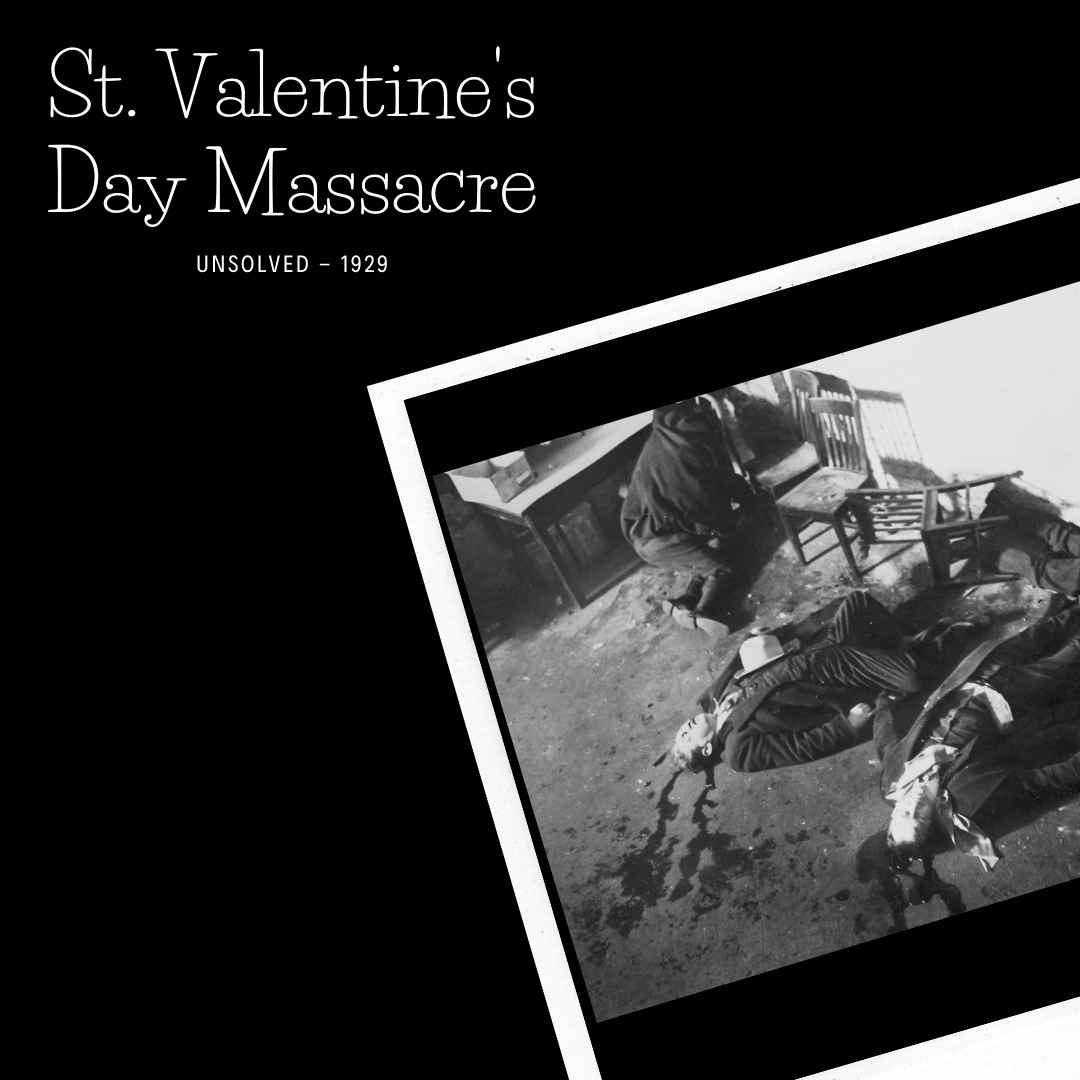
On the cold, dreary morning of February 14, 1929, while people across Chicago were preparing to celebrate St. Valentine’s Day, seven men were waiting in a garage on 2122 North Clark Street. All seven were dressed in suits and ties, too nicely dressed to just be hanging out in the garage. As the men were supposedly waiting for an unknown other or others to arrive, a black Cadillac was seen driving up to the garage. Four to five men, some dressed in police uniforms, and entered the garage. Witnesses reported hearing what they thought was a car engine backing up. It turned out to be the firing of two Tommy guns and a 12-gauge shotgun, firing off 70 rounds of ammunition into the men inside the garage. Six of the seven men were dead when officers arrived, the last one, Frank Gusenberg, dying in the hospital shortly after (“St. Valentine’s Day Massacre”)(“The St. Valentine’s Day Massacre”)(Eig).
The victims were all associated with the gangster George “Bugs” Moran, leading to the immediate suspicion of Al Capone, one of Moran’s enemies. Johnny May worked for Moran as an auto mechanic at the garage and was a retired safe-blower; Frank and Pete Gusenberg were known criminals; Albert Kachellek, known also as James Clark, was an armed robber and reputed killer; Frank Snyder, also known as Adam Heyer, was an accountant and reported embezzler; Albert Weinshank owned a nightclub and had been recently appointed to the Central Cleaner And Dyers Association. The final victim was Reinhardt H. Schwimmer, an optometrist who supposedly hung out at the garage so that he could brag about his connections to Chicago’s underground. Unfortunately for Schwimmer, it may have been those connections that resulted in his death (“St. Valentine’s Day Massacre”)(“The St. Valentine’s Day Massacre”)(Eig).
The seven men were lined up facing the northern wall of the garage, possibly believing the men who had come in were really police, standing shoulder-to-shoulder before being gunned down in a haze of gunfire. Sergeant Thomas Loftus, one of the first on the scene, attempted to get information from the only survivor of the attack, Frank Gusenberg. Gusenberg refused to talk, but some reports indicate that he finally said, “Cops did it” to Loftus. Initially, investigators dismissed the notion that officers were involved, though their reasoning was never adequately explained. In the years since the massacre, evidence has come forward and more possible explanations and suspects have been brought forward (“St. Valentine’s Day Massacre”)(“The St. Valentine’s Day Massacre”)(Eig).
The first suspect was Moran’s enemy, Al Capone. In the 1920s, Prohibition was in action and organized crime was flourishing. Capone and Moran were fighting for control of Chicago’s underground, a gang war that involved people all over the city. Not only were they involved in this war, but they were on opposite sides in a volatile election in the 20th Ward, the aldermanic election. They were fighting over the election, bootlegging, and dry-cleaning rackets across Chicago. All could have been motivation for Capone to hire someone to kill Moran. Capone himself was in Dade County, Florida, meeting with Brooklyn prosecutor Louis Goldstein about the assassination of his friend and mentor, Frankie Yale. Capone later bragged about having an airtight alibi (“St. Valentine’s Day Massacre”)(“The St. Valentine’s Day Massacre”)(Eig).
Moran was a suspect as well. He drove by the garage at the time the massacre occurred and stayed outside, some assume because he saw what he thought were police entering the garage to arrest his men in a raid. He was meant to receive a shipment of bootleg whiskey that day, but left late, which could have potentially saved his life. Some believe he called in the hit, tired of the insubordination of the Gusenbergs and looking to dispose of them. If this was true, why would he sacrifice so many of his men? After the massacre, Moran lost the control he had over his territory due to the significant losses on that day (“St. Valentine’s Day Massacre”)(“The St. Valentine’s Day Massacre”)(Eig).
A group based in Detroit, the Purple Gang, were also brought up as suspects. Moran’s group reportedly hijacked a truck with bootleg whiskey meant for the Purple Gang, which at the time would have been a major blow to their group. The day of the massacre members of the Purple Gang were staying in a room across the street from the garage, assumed by some to be watching for Moran’s men to arrive (Eig).
In December 1929, Fred “Killer” Burke, a known bank robber and hired gun, crashed his car into the police station in St. Joseph, Michigan, and shot the officer who went after him. During the search for him that followed, his home was searched and an arsenal of weapons were found. Among those weapons were ones ballistically matched to the St. Valentine’s Day Massacre and the assassination of Frankie Yale. However, when Burke was arrested in March 1936, he was not charged in relation to either crime and instead was sentenced to life in prison for killing the officer in St. Joseph. Burke died of a heart attack in jail in 1940 (Eig).
Byron Bolton, a bank robber, told investigators that he had information on the massacre in January of 1935, likely hoping to reduce his sentence. Bolton named Burke as one of the killers, along with four others and named himself as the lookout. His claim was that Capone had ordered the hit, but his claim was questionable. At least one of the men he identified had a solid alibi for the time of the massacre. Capone also didn’t have a history of calling for hit squads, especially when he could have called for a single hitman. He knew where Moran lived, if he wanted to send out a hit, it would have been simpler to hire a single hitman than deal with a squad. On top of that, if Moran had been the target, why hadn’t Capone sent more after him (Eig).
When Bolton’s story became public, the head of the Federal Bureau of Investigation, Herbert Hoover, received a letter from a Frank T. Farrell. Farrell claimed to have information useful to the federal government in relation to the massacre. He claimed to have been working undercover at the time of the massacre and knew of a possible motive and suspect. Farrell told Hoover that the police logs in Chicago held the answer – 40-year old former firefighter and son of police sergeant William K. Davern, William Davern Jr. Davern hung out at the C. and O. Restaurant at 509 North Clark Street, where many of Chicago’s gangsters hung out, including the Gusenbergs. In November of 1928, a fight broke out and Davern was shot in the stomach, later dying from his injuries. He had been dragged from the restaurant and dumped at the corner of Rush and then Austin Avenue, now known as Hubbard Street, where he managed to get help and get to a hospital. Davern refused to tell police who shot him, but he did tell his cousin, William “Three-Fingered Jack” White, while on his deathbed. Davern named Moran’s men, including the Gusenberg’s, as those in the fight whole shot him, and White wanted to avenge his cousin’s death. White, who lost two fingers on his right hand, was a well known criminal and had a long rap sheet, including previous incidents with the Gusenbergs (Eig).
In a previous robbery, White had teamed up with the two, but were ratted out by another member of their party. White hired a hitman and sent him after the snitch dressed as an officer, because he believed that people would trust an officer more easily. Farrell claimed that White had contacted the Gusenbergs, claiming he was planning to hit a factory and needed men for the job. If this is true, it would explain why the seven men were dressed so well. They may have been meeting up for business. White could also have enlisted his uncle, getting a squad car and uniforms from him. A week after the massacre, a black Cadillac of police quality was found stripped and burned not far from the massacre location. It may have been the car used in the massacre. If an officer was involved, or multiple, it would explain why investigators focused so much on Capone and didn’t follow up on other leads. A witness of the massacre also reported that the driver of the car was missing a finger (Eig).
In the 1930s, White was an informant for the FBI. If it was known that he was involved in the massacre, it’s possible that the FBI felt he was an important enough informant to cover up his involvement. Unfortunately, those he was working with learned he was working with the federal government and he was killed in his home in January 1934, taking the truth of his involvement with him. His killers have never been caught (Eig).
Did Capone call the hit out on Moran’s men? It did destabilize Moran’s hold on the area. Perhaps Capone knew how important those men were to Moran’s position. Regardless, Capone ended up in prison not long after the massacre on unrelated charges. Moran eventually ended up in prison as well, where he eventually died of lung cancer. The two men may have taken the truth with them to the grave, both having claimed at some point that only the other would kill like that. Perhaps White was the mastermind, seeking revenge for his cousin’s death. The reality is, we may never have the true story of what happened, and society will likely continue to assume Al Capone took out the hit regardless of any new information that may point to other possibilities (“St. Valentine’s Day Massacre”)(“The St. Valentine’s Day Massacre”)(Eig).
Schwartz, Brad. “Opinion | How The St. Valentine’S Day Massacre Changed Gun Laws (Published 2018)”. Nytimes.Com, 2018, https://www.nytimes.com/2018/02/16/opinion/how-the-st-valentines-day-massacre-changed-gun-laws.html.
“St. Valentine’s Day Massacre”. HISTORY, 2021, https://www.history.com/topics/crime/saint-valentines-day-massacre.
“The St. Valentine’s Day Massacre”. HISTORY, 2021, https://www.history.com/this-day-in-history/the-st-valentines-day-massacre.
Eig, Jonathan. “The St. Valentine’s Day Massacre And Al Capone—Excerpt From Get Capone“. Chicago Magazine, 2010, https://www.chicagomag.com/Chicago-Magazine/May-2010/Get-Capone-St-Valentines-Day-Massacre-Jonathan-Eig/.

 Syn Writes